Driveway Gates on Sloped Driveways
How to plan driveway gates on sloped driveways including swing arc, slide gate options, drainage, and operator selection.
By Forge Gates · Published · Substantively updated
Quick answer
A sloped driveway does not automatically require one gate type. The deciding measurements are the change in elevation through a swing leaf’s full arc, the cross-slope at the opening, the available run-back beside the driveway, and where stormwater moves. A sliding or cantilever gate often avoids swing-clearance conflicts, while a swing gate can remain practical when the grade is mild or the hinge geometry and gate position can be adjusted. The choice should be made from a measured site sketch, not from the driveway’s appearance in a photo.
Key takeaways
- Slide gates handle slope better than swing gates by design
- Cantilever slide gates ignore ground level entirely
- Drainage planning matters as much as gate type on sloped sites
Planning notes for Jacksonville homeowners
Measure the driveway in both directions and mark the entire proposed swing arc or slide run-back. Also record drainage paths, vehicle waiting space, fence alignment, and utilities near each post location. Those observations determine whether a concept is buildable before operator size or decorative style is discussed.
Site decision matrix
| Observed condition | Option to compare | Verify on site |
|---|---|---|
| The driveway rises through the proposed swing arc | Sliding or cantilever layout | Run-back length, fence-line grade, post locations, and vehicle clearance |
| There is no side run-back, but the grade through the opening is mild | Measured swing-gate layout | Lowest clearance point, hinge geometry, open-position gap, and wind exposure |
| Water, leaves, or sand collect where a ground track would sit | Cantilever layout or drainage correction before a tracked gate | Water path, erosion risk, maintenance access, and stable footing locations |
| The driveway slopes and curves near the entrance | Repositioned opening or custom layout | Turning path, sight distance, setback, and safe waiting space off the road |
Why swing gates struggle on slopes
A swing gate rotates through an arc. If the ground rises through that arc, the gate drags or stops. If the ground falls through the arc, the gate ends up high above the driveway when open, leaving a gap and an awkward look. Even small slopes that homeowners barely notice while driving can completely defeat a standard swing gate over its full opening arc.
Why slide and cantilever gates win on slopes
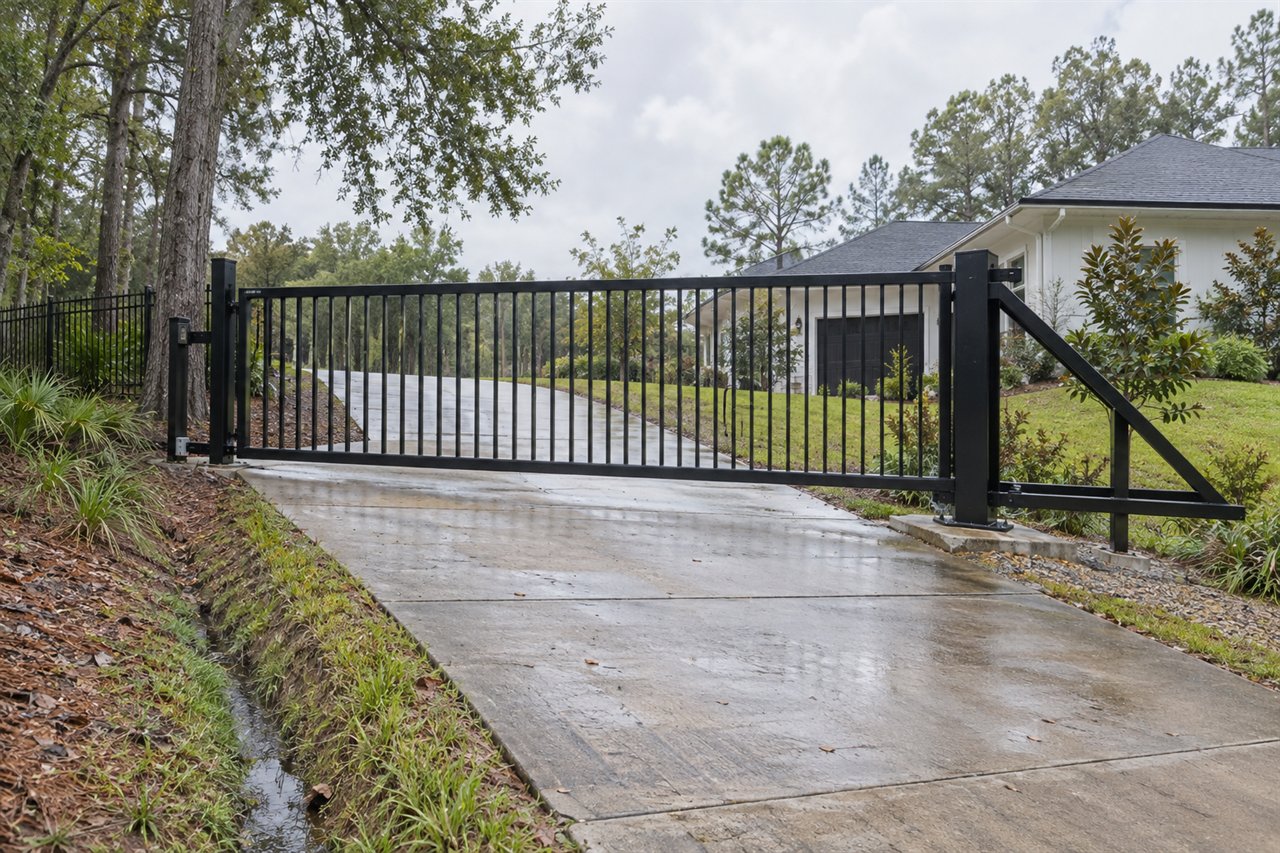
A slide gate moves horizontally along the fence line, which can be set level even when the driveway is not. A cantilever slide gate goes one step further by floating on rollers at the end posts and never touching the ground at all. That makes it the most forgiving option for sloped, uneven, or seasonally muddy sites.
When a swing gate can still work on a slope
If the slope is mild or runs sideways relative to the swing arc, a swing gate can still work with the right hinge geometry. Rising-hinge designs, raised hinge points, or a small level pad poured at the gate location can give the leaf the clearance it needs. This adds design and fabrication complexity, so it should only be chosen when aesthetics make a swing gate strongly preferred.
Drainage and erosion considerations
Sloped driveways move water. The gate location is often where water concentrates before flowing past the property line. Plan a swale, channel drain, or proper grading so water does not pool around posts, undermine footings, or wash out the area beside slide gate tracks. In Florida, summer storm volume makes drainage planning a non-optional part of sloped gate design.
Operator selection for slope and load
Slide gate operators on sloped sites need enough torque to start the gate moving from a stop, not just keep it moving. Swing gate operators on slopes need to push or pull against gravity through part of the arc, which puts extra load on the operator and the hinges. The installer should specify operator brand and horsepower based on the actual leaf weight, slope, and expected daily cycles.
Aesthetic and panel design on a slope
Visual perception of a gate on a slope can mislead homeowners. A gate that looks level in a drawing may sit at a noticeable angle relative to the driveway when installed. Discuss with the installer whether the bottom rail should follow the slope, step in sections, or stay level with a wedge of clearance underneath. Each choice has different implications for security, look, and pet containment.
When this matters most
Driveway rising sharply from the road
A driveway that climbs noticeably from the public road to the gate position is a textbook case for a cantilever slide gate.
Driveway falling away from the gate
When the driveway slopes downward into the property past the gate, a slide gate avoids the awkward arc and gap a swing gate would leave.
Mild side-to-side slope
A driveway with mild lateral slope can sometimes accept a swing gate with raised hinges and a graded leveling pad at the gate location.
Wet, soft soil conditions
Sites with poor drainage benefit from cantilever slide gates that do not use a ground track and from oversized footings on swing posts.
Frequently asked questions
How much slope is too much for a swing gate?
Even modest slopes through the swing arc cause problems. A site visit and measurement is the only reliable way to confirm whether a swing gate is feasible.
Are cantilever slide gates always more expensive?
Cantilever hardware is more expensive than tracked slide hardware, but cantilever designs avoid track-related maintenance and site prep that can offset the cost.
Will a slide gate need a level pad?
A tracked slide gate needs a reasonably level run-out path. A cantilever gate has more tolerance because it does not touch the ground.
What about combination slope and curve?
Driveways that both slope and curve at the gate often need design adjustments such as moving the gate position slightly to a flatter, straighter spot.
Related pages
- Forge Gates Home
- All Guides
- Sliding Driveway Gates
- Driveway Gate Installation
- Gate Installation in Jacksonville
- Gate Installation in Fernandina Beach